I’m a bit of a minimalist when it comes to tooling, so I’m always happy to ditch a tool because its functionality can be provided by something else I’m already using.
In a previous post I described how we use our Build Helper AL app to prep a test suite with the test codeunits and methods that you want to run. Either as part of a CI/CD pipeline or to run from VS Code.
The new extensionId parameter for the Run-TestsInBCContainer function removes the need to prepare the test suite before running the tests. Happily, that means we can dispense with downloading, publishing, installing, synchronising and calling the Build Helper app.
The next version of our own PowerShell module will read the app id from app.json and use the extensionId parameter to run the tests. Shout out to Freddy for making it easier than ever to run the tests from the shell 👍
To be fair, these weren’t the exact words that were used, but a view was expressed from the keynote stage at Directions last week along these lines. Frustration that developers now have to concern themselves with infrastructure, like Docker, and writing automated tests rather than “real” code.
I couldn’t resist a short post in response to this view.
If It Doesn’t Add Value, Stop Doing It!
First, no one is forcing you to write automated tests – apart from Microsoft, who want them with your AppSource app submission. Even then, I haven’t heard of Microsoft rejecting an app because it wasn’t accompanied by enough automated tests.
I’m an advocate of developers taking responsibility for their own practices. Don’t follow a best practice simply because someone else tells you it’s a best practice. You know your scenario, your team, your code and your customers better than anyone else. You are best placed to judge whether implementing a new practice is worth the cost of getting started with it.
AppSource aside, if you are complaining about the amount of time you have to spend on writing tests then you have no one to blame but yourself. Or maybe your boss. If you don’t see the value in writing automated tests then you probably should stop wasting your time writing them!
Automated Tests vs “Real” Code
Part of the frustration with tests seemed to be that they aren’t even “real” code. If by “real” code we are referring to the code that we deliver and sell to customers then no, tests aren’t real code.
But what are we trying to achieve? Surely working, maintainable code that adds value for our customers.
We might invest in lots of things in pursuit of that goal. Time spent manually testing, sufficient hardware to develop and test the code on, an internet connection to communicate with each other and the customer, office space to work in, training courses and materials, coffee. We’re not selling these things to the customer either but no one would question that they are necessary to achieve the goal of delivering working software. Especiallythe coffee.
Whether or not automated tests are “real” code is the wrong question. The important judgement is whether the time spent on writing them makes a big enough contribution to the quality of the product that you eventually ship.
I won’t make the case for automated testing here. That’s for a different post. Or a different book. Suffice to say, I do think it is worth the investment.
But We’ve Got a Backlog of Code Not Covered By Tests
One problem you might have is that you’ve got a backlog of legacy code that isn’t covered by any automated tests. Trying to write tests to cover it all will take ages. This frustration also seemed to be expressed by the speaker at Directions. It even got a round of applause from some of the Directions audience.
My response would be the same – you are best placed to make a pragmatic judgement. Of course it would be nice to have 100% code coverage of your tens of thousands of lines of legacy code – but if you’ll have to stop developing new features for six months to achieve it, is it worth it? Probably not.
Automated tests should give you confidence that the code works as expected. If you are already confident that your existing code works then there might be limited value in writing a suite of tests to prove it.
Try starting with tests to cover new features that you develop or bug fixes. With these cases you’ve got some code that you aren’t confident works as expected – or that you know doesn’t. Take the opportunity to document and prove the expected behaviour with some tests. Over time you’ll build a valuable suite of tests that you can run to demonstrate that each new release of your product works and that bugs haven’t been reintroduced.
With some practice you’ll find that you can use the library codeunits to create scenarios with little test code e.g. you can create a customer, item and sales order, post it and get the posted sales invoice in 2 lines of code.
Seeing as I’m on a bit of a run of posts about testing, let’s look at it from a slightly different angle.
Testing the Test
If we’re going to rely on automated tests to verify that our code (still) works then we need to have confidence that the tests themselves actually work.
Writing the Test First
This is why it is helpful to write and run the tests first. When you start developing a new feature or working on a bug fix you have identified some desired behaviour that the system doesn’t yet exhibit. Giventhis and this, when something or other then this is the behaviour I’m expecting.
Writing a test for that behaviour and seeing it fail confirms that the desired behaviour is missing. That gives you some confidence that you’re on the right lines – the system should do this, but doesn’t – yet.
When you write the bug fix or new feature and see the test pass it gives you much more confidence that your code actually works. You demonstrated beforehand that the desired behaviour was missing and that now it is there. Have a gold star.
Writing the Test Afterwards
You could write the test afterwards and we’ve done a lot of that as we’ve built up tests for our older code that didn’t have any. Whenever I write tests after the fact I do miss the initial stage of having an expected failing test though.
Not completing the given or the whencan be a useful way to test the test. Asserting the expected results when you haven’t done all the required steps should normally cause the test to fail.
For example:
//[GIVEN] an item with my bespoke field populated
LibraryInventory.CreateItem(Item);
SomeBespokeValue := ...;

//leave these lines commented out initially to see the test fail
//Item.Validate("Bespoke Field",SomeBespokeValue);
//Item.Modify(true);

//[WHEN] the item is validated on a sales line
LibrarySales.CreateSalesDocumentWithItem(...)

//[THEN] some bespoke field on the sales line should be set
Assert.AreEqual(SalesLine."Bespoke Field",SomeBespokeValue,...)
Seeing the test fail with those lines commented out and then seeing it pass when you uncomment them will give you more confidence that the test and the behaviour that it is testing work as required. If you are testing code that you think already works and the test always passes it is hard to be sure why the test is passing. Hopefully because the code works – but possibly because the test itself is broken and will always pass, even if the code doesn’t work.
Confidence
The point is to try and get some confidence in your test results. Are you happy to ship the software when all your tests pass? If not, why not? Because you don’t have enough tests? Because you don’t trust that a passing test means working software?
Having a bunch of tests whose results you don’t trust is probably worse than having no tests at all.
Business Central
This is all pretty generic and if you’re interested in the principles you can search for Test-Driven Development (TDD) or Behaviour-Driven Development (BDD) and read what people far more qualified than me have to say about it.
Let’s talk about Business Central specifically for a minute. One of the best things about automated testing compared to manual testing is that everything is rolled back at the end to return the database to the same state it was in at the start. However, that can make life a little difficult when you are trying to inspect the data mid-test and see what is happened.
There are various ways you might want to extract the data at a given moment: write to a file, throw an error with a bunch of values you are interested in, read uncommitted data in SQL. We’ll just talk about two approaches:
Debugger
You can debug test code just like any other code. Set a breakpoint in your test, attach the debugger and run the test from the Test Tool page. Step through, add watches and evaluate debug expressions. The debugger in VS Code is getting better all the time, exposing more details about the variables you are interested in and SQL statements that have been executed.
Perfect for diving into the details and stepping through line by line, but not always the easiest to get an overview of what is happening.
Another Client Session
Another option is to open another client session while you are debugging. Set a breakpoint, attach the debugger and start running a test from the Test Tool page.
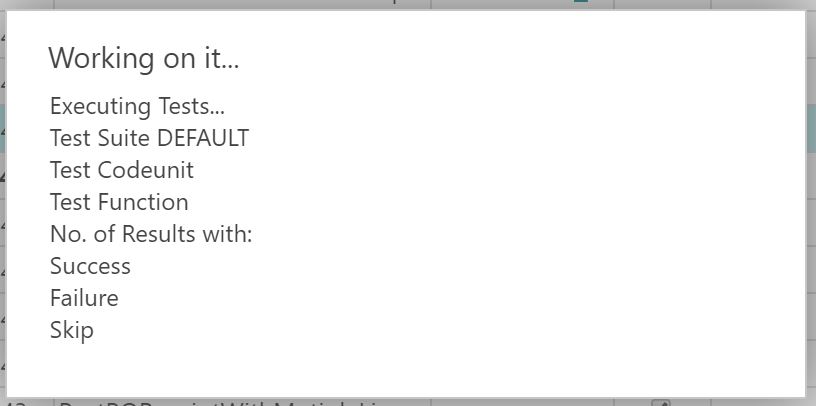
Debugging the test will block the session that you started it from – you’ll get the “working on it” dialog – but you can open a different session in another tab or in another browser.
The only snag with this is that some of the records that you want to read might be locked and you’ll get an error trying to open the corresponding page.
“The operation could not complete because a record was locked by another user.” Bummer.
Turns out there is another way to read the data in that session.
Avoid Locks With Page=<pageid>
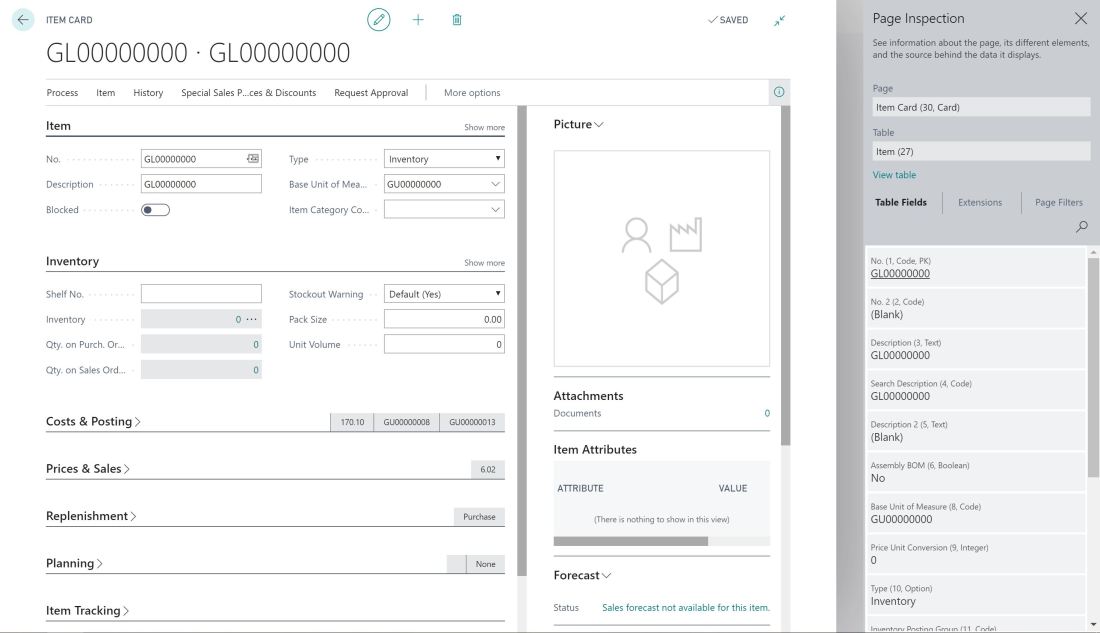
You can add parameters to the web client URL to navigate to specific tables, reports or pages. In my example I can’t open the Items list from the menu because the record is locked by another user.
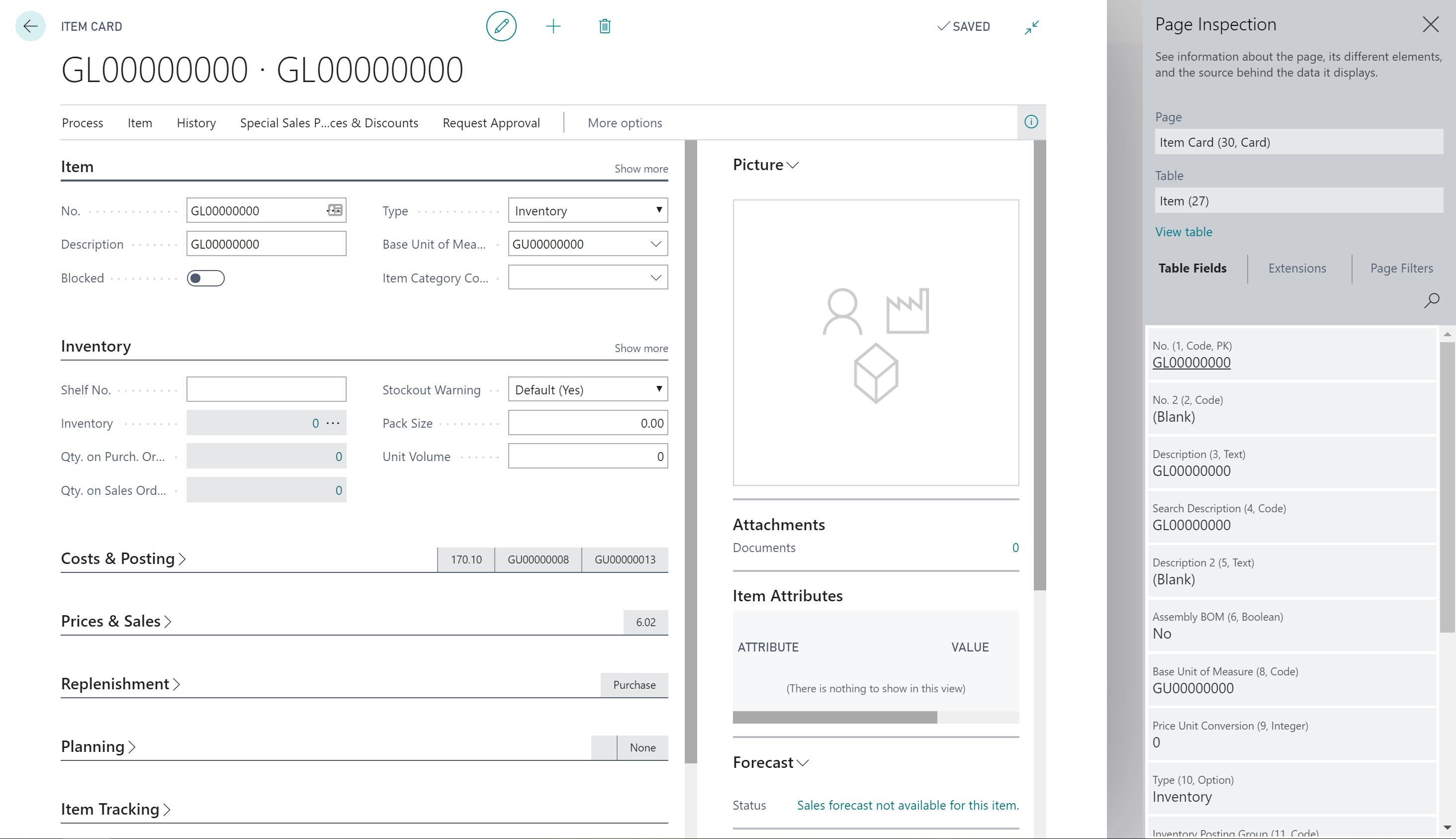
If I go to the Item List page with http://<base web client URL>?page=32 then the page loads with my test data. I can open the item card, navigate to other pages and run the Page Inspector (Ctrl+Alt+F1) to view all the fields in the table, filters, extension details etc.
As I step through the code in the VS Code debugger I can refresh the pages in this session and see the updates to the record. Beautiful.
Further Reading
If you’re interested in getting stuck into testing in Business Central grab yourself a copy of Automated Testing in Microsoft Dynamics 365 Business Central.
It was my pleasure to make a small contribution to this book as a technical reviewer and writing the foreword.
Another instalment of my musings on running automated tests for Microsoft Dynamics 365 Business Central from Visual Studio Code.
Objective
What are we up to this time? As a brief reminder, I’m trying to make it as easy as possible to run automated tests from Visual Studio Code. I figure the faster and simpler it is to publish your code changes and run the tests the more inclined you are going to be to do it. The more you test the better your code will be.
If you’re trying to follow a discipline like Test-Drive Development you need tight feedback loops writing code and running tests. Being able to do that from the IDE and without having to switch back and forth to the browser is so much nicer.
To that end, if you are working on a particular test codeunit maybe it makes sense to only run the tests in that codeunit – in the interests of getting the feedback from those tests as quickly as possible. Or maybe just running the single test method that you’re working on. Once, you’re happy with those changes you can run the whole test suite again to make sure you haven’t broken anything else in the meantime.
Fortunately, it turns out we’ve already got the pieces we need to assemble this jigsaw.
NavContainerHelper
Being the considerate sort of chap that he is, Freddy has already included testCodeunit and testFunction parameters for the Run-TestsInNavContainer function. We just need to figure out how to plug the right values into those parameters.
Some More About VS Code Tasks
In this post I showed how you can define a task in VS Code to run some PowerShell. It turns out you can do more in tasks.json than I realised.
This is what my file looks like now:
{
    // See https://go.microsoft.com/fwlink/?LinkId=733558
    // for the documentation about the tasks.json format
    "version": "2.0.0",
    "tasks": [
        {
            "label": "Run BC Tests",
            "type": "shell",
            "command": "Run-TestsFromVSCode -CurrentFile ${file} -CurrentLine ${lineNumber}",
            "group": {
                "kind": "test",
                "isDefault": true
            },
            "presentation": {
                "echo": true,
                "reveal": "always",
                "focus": false,
                "panel": "shared",
                "showReuseMessage": true,
                "clear": true
            }
        }
    ]
}
The presentation object controls the behaviour of the terminal that the task is run in. I’m just using it to clear the terminal each time.
The really interesting part is ${file} and ${lineNumber}. These placeholders are replaced with the current file and current line number in the editor when the task is executed. Ooooo. You can probably see where I’m going with this. That’s all the information we need to run the current test codeunit and method.
I’ve created a new Run-TestsFromVSCode function in our PowerShell module to handle this. Notice I’m calling that function from the task now instead of our Run-BCTests function directly.
Run-TestsFromVSCode
Assuming a file path has been passed to the function it determines whether the current file is a test codeunit i.e. does it contain the text “Subtype = Test”? If so, use Regex to find the id of the codeunit from the first line.
Now attempt to find the previous declaration of a test function from the current line no (search backwards for a line that contains “[Test]” then forwards from that line to a procedure declaration).
Then call Run-BCTests with all the information that you’ve been able to find. Passing an asterisk rather than blank for the codeunit and/or method acts as a wildcard and will run everything, instead of nothing.
function Run-TestsFromVSCode {
    param(
        # The current file the tests are invoked from
        [Parameter(Mandatory=$false)]
        [string]
        $CurrentFile,
        # The current line no. in the current file
        [Parameter(Mandatory=$false)]
        [string]
        $CurrentLine
    )

    if ($null -eq $CurrentFile) {
        Run-BCTests
    }
    else {
        # determine if the current file is a test codeunit
        if ((Get-Content $CurrentFile -Raw).Contains('Subtype = Test')) {
            $TestCodeunit = [Regex]::Match((Get-Content $CurrentFile).Item(0),' \d+ ').Value.Trim()
            if ($null -ne $CurrentLine) {
                $Method = Get-TestFromLine -Path $CurrentFile -LineNumber $CurrentLine
                if ($null -ne $Method) {
                    Run-BCTests -TestCodeunit $TestCodeunit -TestMethod $Method
                }
                else {
                    Run-BCTests -TestCodeunit $TestCodeunit -TestMethod '*'
                }
            }
        }
        else {
            Run-BCTests
        }
    }
}

function Get-TestFromLine {
    param (
        # file path to search
        [Parameter(Mandatory=$true)]
        [string]
        $Path,
        # line number to start at
        [Parameter(Mandatory=$true)]
        [int]
        $LineNumber
    )

    $Lines = Get-Content $Path
    for ($i = ($LineNumber - 1); $i -ge 0; $i--) {
        if ($Lines.Item($i).Contains('[Test]')) {
            # search forwards for the procedure declaration (it might not be the following line)
            for ($j = $i; $j -le $Lines.Count; $j++)
            {
                if ($Lines.Item($j).Contains('procedure')) {
                    $ProcDeclaration = $Lines.Item($j)
                    $ProcDeclaration = $ProcDeclaration.Substring($ProcDeclaration.IndexOf('procedure') + 10)
                    $ProcDeclaration = $ProcDeclaration.Substring(0,$ProcDeclaration.IndexOf('('))
                    return $ProcDeclaration
                }
            }
        }
    }
}

Export-ModuleMember -Function Run-TestsFromVSCode
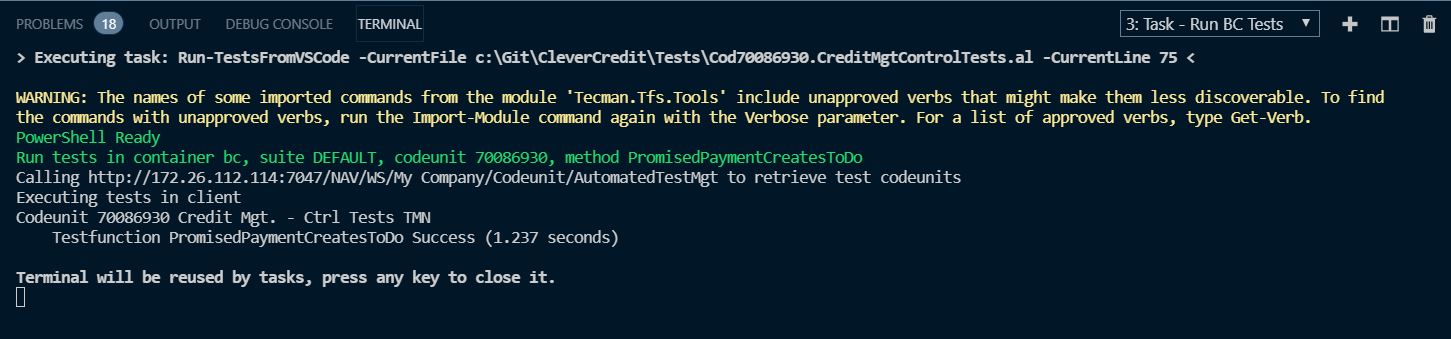
The terminal output from the task now looks like this:
Notice the current file and line number passed to the task and the current codeunit id and method passed to navcontainerhelper to run.
To run all the methods in the current codeunit move the cursor above the line of the first test method declaration.
To run all methods in all codeunits move the cursor outside a test codeunit – although you must have some file open otherwise VS Code will fail to resolve the ${file} and ${lineNumber} placeholders.
You could of course define more tasks to run these options if you prefer.
Conclusion
All of this enables this kind of workflow, if that’s what you’re into:
Create a new (failing) test and publish app
Run (just) that test and check that it fails
Write production code and publish app
Run (just) that test and check that it now passes
Run all the tests in that codeunit / your whole suite
Commit your changes
Wish List
I’m pleased with how far I’ve been able to get, but there’s still some significant items not crossed off the wish list.
Debugging Tests
For now you still have to launch the browser (at least we can debug without publishing these days) and start the test from that session. I believe the old “debug next” functionality we used to have in the Windows client debugger is on the roadmap somewhere. That would do the trick.
Performance
Leaves a lot to be desired. Running a single method in a single test codeunit takes anywhere between 6 and 10 seconds. Obviously, some of that time is the test itself and is in our control, but most of that is preparing the suite and creating and connecting the client.
I know Microsoft are overhauling how tests are executed by the platform, so maybe some performance gains are also in the pipeline.
Last time out we went through running automated tests from the PowerShell terminal integrated into VS Code. We saw that you could define a task in the tasks.json file to run the tests and assign a keyboard shortcut for that task.
Great. But. In order to run tests they first need to have been added to a test suite. You could add some code to an install codeunit in your app to do that for you (see here). That approach is nice and clean, but leaves a couple of things to be desired:
What if you want to specify the test suite, or codeunit(s) that you want to use?
How can you clear the test suite?
You can’t. Which is why we have a “Build Helper” app to add and remove test codeunits from test suites. It contains a single codeunit which is exposed as a web service which we call from PowerShell.
This is the codeunit and the PowerShell it is called with (see here if you can’t see the embedded gist).
This file contains hidden or bidirectional Unicode text that may be interpreted or compiled differently than what appears below. To review, open the file in an editor that reveals hidden Unicode characters. Learn more about bidirectional Unicode characters
This file contains hidden or bidirectional Unicode text that may be interpreted or compiled differently than what appears below. To review, open the file in an editor that reveals hidden Unicode characters. Learn more about bidirectional Unicode characters
I think the AL is pretty self-explanatory. The PowerShell is a little more interesting.
Install-BuildHelper acquires the latest version of the app from the build artefacts (as described here). It checks whether it is already installed first by attempting to reach the address of the WSDL (http://<server + port>/NAV/WS/Codeunit/AutomatedTestingMgt). I’ve found that to be a little faster than Get-NavContainerAppInfo.
It uses New-WebServiceProxy (as described here) to call the web service methods.
Get-ContainerCompanyToTest fetches the name of (usually) the first company in the container to call the service against. It does this calling the SystemService web service rather than Get-CompanyInNavContainer – again, as it is slightly faster.
By “faster” I mean a couple of seconds. That’s trivial compared to the execution time of the test suite but given that I’m trying to move to a tighter {develop test -> run tests -> develop app -> run tests} loop I’ll take the saving.
I’m a fan of default values so it:
Takes the container from launch.json
Creates a credential object using the credentials we store in our environment.json file
Takes the start and end of the range of codeunits to add from the idrange set in app.json
There is a Clear-TestSuite function as well. I haven’t bothered pasting it here because it’s just a simplified version of Get-TestCodeunitsInContainer.





 James Pearson